Light Lager: What It Is and How the Style Works
What It Is and How the Style Works
Light lager is a very pale, very light-bodied lager with minimal malt and hop flavor, low bitterness and a crisp, dry, highly carbonated finish. In the BJCP guidelines, American light lager sits at 2.8 to 4.2% ABV, making it lighter in body and alcohol than a standard American lager.
It is also, by a long way, the most commercially successful beer style in American history. According to the BJCP, beers of this type were the best-selling category in the United States by the 1990s.
Quick facts
- Family: lager
- ABV: 2.8 to 4.2% (BJCP 2021, American Light Lager)
- Bitterness: 8 to 12 IBU
- Color: 2 to 3 SRM, very pale straw
- Key flavors: faint grainy or corn sweetness, very low hops, clean fermentation, dry finish
- Common adjuncts: rice or corn
- Close relatives: American lager (4.2 to 5.3% ABV, 8 to 18 IBU), international pale lager
What light lager tastes like
Not much, on purpose. That sounds like an insult, but the BJCP says it directly: the style is designed to appeal to the widest possible audience, and strong flavors are a fault.
What you should get is a clean, light grainy note, maybe a faint sweetness from corn or rice, almost no hop aroma, and a crisp, bubbly, dry finish. Because there is so little malt or hops, the yeast character is often what distinguishes one brand from another. The best ones are flawless in a way that is actually hard to brew: with nothing to mask a defect, any off-flavor stands out.
If you want to practice tasting, light lager is a surprisingly good teacher. See how to taste beer.
How light lager is made
Light lager is brewed like other American lagers, with a few adjustments:
- Adjuncts. Rice or corn lighten the body and color and help the beer ferment very dry.
- High attenuation. Brewers aim for almost all the fermentable sugar to be converted, which leaves very little residual sweetness or body.
- Cold lager fermentation. Clean lager yeast, fermented cold and conditioned cold, keeps the profile neutral. See beer yeast: ale vs lager.
- Light hopping. Just enough to balance, rarely enough to notice.
For a fuller walkthrough of brewing, see how beer is made.
Light lager history
The BJCP traces the style through three steps. Coors made a short-lived light lager in the early 1940s. Rheingold released the first modern version in 1967. The style took off after 1973, when Miller acquired the recipe and marketed it heavily, and within two decades light beers were the top-selling category in the country.
Light lager descends from American lager, which itself came out of the post-Prohibition consolidation of US brewing. Surviving breweries merged, expanded distribution and leaned into a mild, broadly appealing beer. Light lager took that idea one step further.
Light lager vs regular lager
| Light lager | American lager | |
|---|---|---|
| ABV (BJCP) | 2.8 to 4.2% | 4.2 to 5.3% |
| IBU | 8 to 12 | 8 to 18 |
| Color (SRM) | 2 to 3 | 2 to 3.5 |
| Body | very light | light |
"Light" in this style refers to body and strength, not color. Plenty of beers are light in color without being light lagers; a pilsner or a kölsch is pale but fuller-flavored.
When "light" is not light
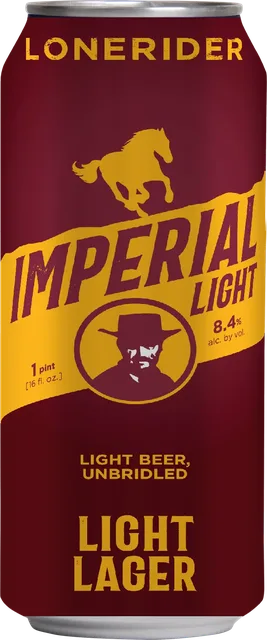
Style names are descriptions, and brewers do not always stay inside them. Some beers borrow the light lager profile (very pale color, clean lager fermentation, crisp finish) while sitting far outside the style's alcohol range. When that happens, the label's ABV figure is the number that matters, not the word "light." Always check it. See how to read a beer label and ABV and IBU explained.
How to serve and pair it
Serve light lager cold, around 35 to 40°F. This is one style where very cold is fine, because there are few delicate aromas to lose. See beer serving temperature. Keep it out of sunlight: light lagers in clear or green glass are especially prone to skunky, light-struck flavor, which the BJCP treats as a handling fault. More in how to store beer.
For food, think simple and salty: pretzels, wings, hot dogs, fish tacos, grilled chicken, mildly spicy dishes. Light lager will not compete with the food, which is the point.
From the Lonerider lineup
Imperial Light is an unusual take on the style: a light lager at 8.4% ABV, which is well outside the typical range for light lager.
FAQ
What is a light lager?
A very pale, light-bodied lager with low bitterness and little malt or hop flavor, finishing crisp and dry. The BJCP puts American light lager at 2.8 to 4.2% ABV and 8 to 12 IBU.
What is the difference between light beer and regular beer?
Light lager has a lighter body and usually less alcohol than a standard American lager, which the BJCP puts at 4.2 to 5.3% ABV. It is brewed to ferment very dry, so there is less residual malt and flavor.
Does light lager mean low alcohol?
Usually lower, but not always. The style typically falls between 2.8 and 4.2% ABV, but some beers labeled light are much stronger, so always check the ABV on the label.
When was light beer invented?
Coors made a short-lived version in the early 1940s, and Rheingold released the first modern light lager in 1967. It became a national category after Miller began marketing its version in 1973.
Why does light lager taste skunky sometimes?
Light exposure. Light reacts with hop-derived compounds in the beer and creates a skunky-smelling one, especially in clear or green bottles. It is a storage fault, not part of the style.