
What Is Bourbon? The Rules, the Mash Bill and the Barrel
Bourbon is an American whiskey made from a fermented mash of at least 51% corn, distilled to no more than 160 proof, put into charred new oak barrels at no more than 125 proof, and bottled at 80 proof or higher. It must be distilled and aged in the United States, and nothing can be added to it for color or flavor.
That is the whole legal definition, and it lives in a single federal regulation: 27 CFR 5.143, the standards of identity for whisky. Everything else you hear about bourbon (Kentucky, limestone water, sour mash, a minimum age) is either tradition, marketing or a rule that applies only to a narrower category.
Quick facts
- Grain: at least 51% corn in the mash. The rest is usually rye or wheat plus malted barley.
- Distillation: 160 proof (80% ABV) or less.
- Barrel: charred new oak, filled at 125 proof (62.5% ABV) or less.
- Bottling strength: at least 80 proof (40% ABV), the minimum for all whisky.
- Additives: no coloring, flavoring or blending materials.
- Where: distilled and aged in the United States. Any state counts.
- Minimum age: none for plain bourbon. "Straight" bourbon needs at least 2 years.
The legal definition of bourbon, rule by rule
Federal law first defines whisky in general: a distillate from a fermented mash of grain, distilled at less than 190 proof, stored in oak (with an exception for corn whisky), and bottled at no less than 80 proof. Bourbon is one type inside that class.
At least 51% corn. The mash, the cooked and fermented porridge of grain that gets distilled, has to be majority corn. Most bourbons go well past that, often into the 60s or 70s. The remaining grains are what distillers call the flavor grains, and they shape the whiskey more than their share suggests. See high rye bourbon for how that works.
Distilled to 160 proof or less. A lower distillation proof leaves more grain flavor in the spirit and keeps bourbon well away from neutral spirit.
Charred new oak barrels, entered at 125 proof or less. The barrel must be new, made of oak, and charred on the inside. A barrel can only make bourbon once; after that it often goes on to age Scotch, rum, tequila or beer. The char and the fresh wood are responsible for bourbon's vanilla, caramel and toasted sugar notes, and for most of its color.
Bottled at 80 proof or more. Water can bring the whiskey down from barrel strength, but not below 40% ABV.
No coloring or flavoring. Some other whiskies may legally contain small amounts of caramel color or blending materials. Bourbon may not. The color in the glass came from the barrel.
Made in the United States. The regulation says the word "bourbon" may not be used for any whisky not distilled and aged in the US. Congress went further in a 1964 concurrent resolution that called bourbon "a distinctive product of the United States."
Notice what is missing: a minimum aging time. Plain bourbon has none, though any whisky aged less than 4 years must carry an age statement, so very young bourbon announces itself on the label.
Myth: bourbon has to come from Kentucky
It does not. Kentucky is bourbon's historic home and its best-known address, but the law only requires the United States. Distillers in many states make bourbon, and every one of those bottles is just as much bourbon as anything from Bardstown, provided it meets the same grain, proof and barrel rules.
Myth: sour mash is a special kind of bourbon
Sour mash is a process, not a category, and it has nothing to do with sour flavor. In a sour mash setup, the distiller adds some backset (the acidic liquid left over from a previous distillation) to the new mash. That lowers the pH, which helps the yeast and keeps unwanted bacteria in check, and it makes batch to batch results more consistent. A "sweet mash" bourbon skips the backset. Neither term is part of the legal definition.
Bourbon vs whiskey: what is the difference?
All bourbon is whiskey; not all whiskey is bourbon. The difference comes down to grain and wood.
- Rye whiskey follows the same rules as bourbon, but the 51% minimum grain is rye instead of corn.
- Wheat whiskey and malt whiskey work the same way with wheat or malted barley.
- Corn whisky needs at least 80% corn and, if it is aged at all, goes into used or uncharred new oak. That is the opposite of bourbon's barrel rule.
- Whisky distilled from bourbon mash uses a bourbon recipe but ages in used barrels, so it cannot be called bourbon.
- Scotch, Irish and Japanese whisky follow their own countries' rules, and most of them age in used barrels, many of which once held bourbon.
Same mash, used barrel: whiskey. Same mash, fresh charred barrel: bourbon.
Is Tennessee whiskey bourbon?
Tennessee whiskey is made much like bourbon, and Tennessee state law sets its own definition: the whiskey must be made in Tennessee, aged there in new charred oak barrels, and filtered through maple charcoal before it goes into the barrel. Producers there prefer their own name.
What "finished" bourbon means
A finished bourbon ages first in charred new oak, as the law requires, then spends time in a second cask (sherry, wine, rum, tequila or beer). The label says so, as in "bourbon whiskey finished in sherry casks." See cask finished whiskey.
From Lonerider Spirits
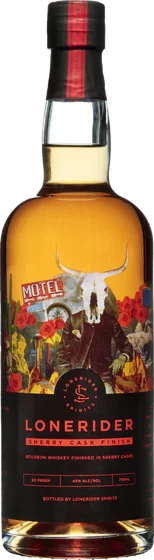
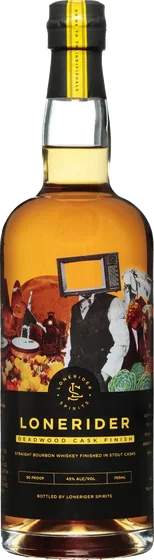
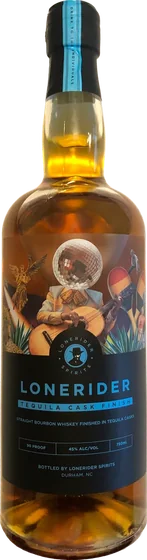
Three bourbons, each with a cask finish, all 90 proof. Sherry Cask Finish, the flagship, is a high rye bourbon whiskey finished in sherry casks, with cinnamon, candied apple and toffee up front. Deadwood Cask Finish is a robust straight bourbon whiskey finished in stout casks. Tequila Cask Finish is a light, easy straight bourbon whiskey finished in tequila casks, at home where a cocktail calls for an anejo tequila.
FAQ
Does bourbon have to be made in Kentucky?
No. Federal law requires only that bourbon be distilled and aged in the United States. Kentucky is the most famous bourbon state, but bourbon from any state is held to the same legal standard.
How long does bourbon have to be aged?
There is no minimum age for bourbon itself, only a requirement that it go into charred new oak barrels. Straight bourbon must age at least 2 years, and any whisky under 4 years old must carry an age statement on the label.
What percentage of corn is in bourbon?
At least 51% of the mash must be corn. Most bourbons use more, and the rest of the recipe is typically rye or wheat with some malted barley.
Can bourbon have additives?
No. Bourbon cannot contain added coloring, flavoring or blending materials. Water can be added to bring it down to bottling strength, which must be at least 80 proof.
Is all whiskey bourbon?
No. Bourbon is one type of whiskey with specific rules for grain, proof, barrels and origin. Rye, corn whisky, Scotch and Irish whiskey are all whiskey, but none of them is bourbon.
Sources
- 27 CFR 5.143, Whisky (eCFR)
- 27 CFR 5.74, Statements of age, storage, and percentage (eCFR)
- Concurrent resolution on bourbon whiskey, 78 Stat. 1208 (1964), GovInfo
- The Difference Between Sweet Mash and Sour Mash, Explained (VinePair)
- On the Rocks: Major Liquor Makers Wage Whiskey War in Tennessee (NBC News)