Mexican Lager: Styles, Vienna Roots and the Lime Question
Styles, Vienna Roots and the Lime Question
Mexican lager is a clean, crisp, light-bodied lager, usually pale gold, often brewed with a portion of corn, with low bitterness and a dry finish built for warm weather. There are also amber and dark versions, which trace back to the Vienna lager that Austrian and German brewers brought to Mexico in the 1800s.
For a long time, competition guidelines had no Mexican lager category at all. That changed recently: the Brewers Association now describes four Mexican-style lagers (light, pale, amber and dark).
Quick facts
- Family: lager
- BA styles: Mexican-style light, pale, amber and dark lager (added to BA guidelines in 2025)
- Typical pale examples: BJCP files these under International Pale Lager, 4.5 to 6% ABV, 18 to 25 IBU, 2 to 6 SRM
- Amber and dark roots: Vienna lager, 4.7 to 5.5% ABV, 18 to 30 IBU, 9 to 15 SRM (BJCP 2021)
- Common adjuncts: corn (flaked or malted), sometimes rice
- Key flavors: light grainy or corn sweetness, low noble-type hops, clean fermentation, dry finish
What Mexican lager tastes like
The pale versions most people know are light in body and color, with a soft grainy sweetness, sometimes a faint corn note, very little hop aroma and a crisp, dry finish. Bitterness is low. The BA describes the whole family as clean, with only low fruity esters allowed and no buttery diacetyl.
The amber and dark styles are a different experience: copper to brown, with bready, toasty or caramel malt, still low in bitterness and still drinkable. These are the closest living relatives of 19th century Vienna lager.
The four Mexican-style lagers
According to the Brewers Association's 2025 additions:
- Light: straw to pale gold, very light body, very low bitterness, dry finish.
- Pale: pale to deep gold, low to medium-low malt sweetness, low noble-type hop character, dry finish.
- Amber: light amber to copper, caramel and bready malt, light creaminess.
- Dark: dark copper to dark brown with ruby highlights, toasty, bready malt, dry finish.
All four allow corn or rice. The BA has noted that corn can make up as much as 40% of the grain bill, and that it supports the dryness and easy drinkability the style is known for.
Vienna lager roots in Mexico
Vienna lager was developed by Anton Dreher in Vienna in 1841: an amber, toasty, moderately bitter lager made with a lightly kilned malt that also took the Vienna name. It was popular across Central Europe through the late 1800s.
According to the BJCP, Santiago Graf and other Austrian immigrant brewers brought the style to Mexico in the late 1800s, and it took root there. Mexican amber and dark lagers are its descendants. The BJCP also notes that many of these traditional examples have since become sweeter and more adjunct-heavy, so some now sit closer to international amber or dark lager than to the original Vienna style.
The pale Mexican lagers developed alongside the global rise of light, crisp, pilsner-type beers in the 20th century. The BJCP groups them with other mass-market international pale lagers and lists "Mexican lager" as a regional variation a competitor can name.
Why corn?
Corn is not a shortcut in Mexican lager; it is part of the identity. The BA's 2026 style spotlight opened with the phrase "sin maíz, no hay país" (without corn, there is no country). Corn lightens the body, adds a subtle sweetness and helps the beer finish dry. Malted corn adds more flavor than flaked corn. For more on how grains shape beer, see malt explained.
The lime question
Short answer: nobody knows for sure where the lime-in-beer habit started, and the popular origin stories are unverified.
You will hear that limes kept flies off bottle necks, that they cleaned rust from bottle caps, or that a bartender started the trend on a bet in 1981. Snopes looked at these and found no clear answer; the bartender story traces back to a single 2008 marketing book that names neither the bar nor the bartender. The likeliest explanation is that the lime wedge became popular in the United States and was reinforced by marketing.
Should you add one? That is up to you. Lime adds acidity and aroma that suit a very light lager, especially with food. It also covers up the beer's own flavor and can flatten the foam, so try a good Mexican lager without it first. Note that a lime does nothing about light-struck, skunky flavor. The BJCP calls skunkiness a handling fault, not part of the style. Clear and green bottles let light in, which is one reason cans are a good choice here. See cans vs bottles.
How to serve and pair it
Serve pale Mexican lager cold, around 38 to 42°F, and amber or dark versions a few degrees warmer. See beer serving temperature. Pair with tacos, grilled fish, ceviche, carnitas, elote, salsas and anything with lime and chili. Amber and dark versions go well with mole, grilled meats and barbecue.
From the Lonerider lineup
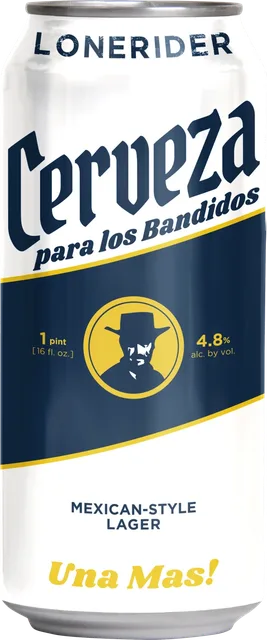
Cerveza para los Bandidos is a Mexican-style lager at 4.8% ABV.
FAQ
What is a Mexican lager?
A clean, crisp lager, usually pale and light-bodied, often brewed with corn and low in bitterness. The Brewers Association recognizes four Mexican-style lagers: light, pale, amber and dark.
Why do people put lime in Mexican beer?
No one knows for certain. Stories about flies and rusty caps are unverified, and the most likely explanation is a US serving trend reinforced by marketing. It is optional.
What is the difference between Mexican lager and American lager?
They are close cousins. Both are pale, light-bodied lagers that often use adjuncts, but Mexican lagers typically use corn and lean a little drier and grainier. Mexico also has a tradition of amber and dark lagers descended from Vienna lager.
Is Mexican lager made with corn?
Often, yes. The Brewers Association guidelines allow corn or rice in all four Mexican-style lagers, and corn can make up a large share of the grain bill.
What is a Vienna lager?
An amber lager created by Anton Dreher in Vienna in 1841, with toasty malt and moderate bitterness. Austrian brewers brought it to Mexico in the late 1800s, and Mexican amber and dark lagers descend from it.