Malt Explained: What It Is and How It Shapes Beer
What It Is and How It Shapes Beer
Malt is grain, usually barley, that has been soaked, allowed to sprout briefly and then dried in a kiln. That process unlocks the enzymes and sugars brewers need, and the kilning step sets most of a beer's color and much of its flavor, from pale cracker to toffee to dark roast.
If hops are the seasoning, malt is the meal. It provides the sugar yeast turns into alcohol, it decides whether a beer is straw gold or black, and it carries the bready, caramel, nutty or chocolate flavors people describe as "malty."
Quick facts
- Most common grain: barley, though wheat, rye and oats are malted too.
- Three steps: steeping, germination, kilning.
- Steeping raises moisture from about 12 to 13 percent to roughly 42 to 46 percent.
- Germination takes about 3 to 5 days.
- Pale malt is kilned around 176 to 185°F; darker malts go much hotter.
- Base malts make up most of a recipe; specialty malts are used in smaller amounts for color and flavor.
Why brewers malt grain at all
A barley kernel is a seed. Inside is a store of starch meant to feed a new plant, and that starch is packed tightly enough that yeast cannot use it. When the seed starts to sprout, it produces enzymes to break that starch down into food for the growing shoot.
Malting hijacks that moment. The maltster lets the grain begin to grow just long enough to build enzymes and soften the starch, then stops it with heat before the shoot eats the goods. The brewer later reactivates those enzymes in the mash, where they convert starch into fermentable sugar. That is why the brewing process starts with malt rather than raw grain.
How malting works
Steeping. Barley is soaked in water, usually in cycles of wet and dry rest, until its moisture climbs from about 12 or 13 percent to somewhere around 42 to 46 percent. Pale malts aim at the low end of that range; darker malts sit higher.
Germination. The wet grain is spread out and kept cool, roughly 55 to 64°F, for about three to five days. A rootlet appears and a shoot (the acrospire) grows under the husk. Maltsters judge progress by how far that shoot has grown along the kernel; when it is close to the full length, the grain is well "modified," meaning its starch is accessible and its enzymes are in place.
Kilning. Hot air dries the grain, first gently to protect the enzymes, then hotter to finish. Pale base malt is typically kilned around 176 to 185°F for a few hours. Push the heat higher and longer and you get darker malts, as Maillard reactions build melanoidins, the same family of browning compounds that gives bread crust and seared steak their flavor. Above roughly 194°F those flavors become pronounced. The trade-off: the darker the malt, the fewer working enzymes survive.
Base malts vs specialty malts
Base malts are lightly kilned and keep strong enzyme power. They make up most of the grain in nearly every beer, and they convert their own starch plus that of any specialty malts riding along. Common examples:
- Pilsner malt: very pale, clean, slightly grainy. The backbone of most lagers.
- Pale ale malt: a touch more kilned, with a little more toasty depth.
- Munich and Vienna malts: kilned hotter for bready, toasty richness while still converting themselves.
- Wheat malt: soft and bready; the base of hefeweizen and a supporting player in kolsch.
Specialty malts are used in smaller doses for color, flavor and body:
- Crystal or caramel malts: the green malt is "stewed" at mash-like temperatures so starch turns to sugar inside the husk, then kilned. The result adds caramel and toffee flavor and leaves some unfermentable sugar that adds body.
- Chocolate and black malts: roasted at high temperature for cocoa, coffee and dark color. A little goes a long way.
- Roasted barley: unmalted barley roasted dark, sharper and drier than chocolate malt. It is the signature of dry stout; see porter vs stout.
How malt shows up in your glass
Color. Nearly all of a beer's color comes from malt. Brewers measure it on the SRM scale (or EBC in Europe); a pale lager sits in the low single digits, while the BJCP guidelines put American brown ale at 18 to 35 SRM, and stouts run darker still.
Flavor. Pale malts read as cracker, bread or honey. Crystal malts add caramel, toffee and dried fruit. Roasted malts add chocolate, coffee and char.
Body and sweetness. How much unfermentable sugar is left after fermentation decides whether a beer feels thin and dry or full and round. Specialty malts and mash temperature both steer this.
Alcohol. More malt means more sugar, and more sugar means more alcohol. That relationship is why gravity readings predict ABV; see ABV and IBU explained.
Balance with hops. Malt sweetness is the counterweight to hop bitterness. A beer with the same IBU number can taste sharply bitter or nearly balanced depending on how much malt is behind it.
From the Lonerider lineup
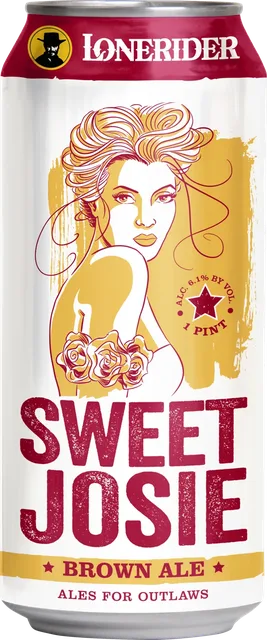
For a malt-forward example, try Sweet Josie, an American brown ale at 6.1% ABV and 30 IBU. Brown ale is built on the caramel, toast and light chocolate side of the malt spectrum, and Sweet Josie took a GABF gold medal for brown ale in 2010. More on the style in American brown ale.
FAQ
What is malt in beer?
Malt is grain, usually barley, that has been soaked, sprouted and kiln-dried. It supplies the sugar yeast ferments into alcohol, plus most of the beer's color, malty flavor and body.
What does malty mean in beer?
Malty describes flavors that come from the grain: bread, cracker, biscuit, caramel, toffee, toast, nuts, chocolate or coffee. A malty beer tastes more of those than of hops.
Is malt the same as barley?
No. Barley is the raw grain. Malt is barley (or another grain) that has gone through steeping, germination and kilning. Brewers can use some unmalted barley, but they need malted grain for its enzymes.
What is the difference between base malt and specialty malt?
Base malt is pale, has strong enzyme power and makes up most of the recipe. Specialty malt is kilned or roasted for color and flavor, has little or no enzyme power and is used in smaller amounts.
Does malt have gluten?
Barley, wheat and rye malts contain gluten. Gluten-free beers use grains such as sorghum, millet or rice instead. Some brewers use enzymes to break gluten down in barley beer, but that is not the same as a beer made without gluten grains.