
What Does Straight Bourbon Mean? The 2-Year Rule and Bottled in Bond
Straight bourbon is bourbon that has been stored in charred new oak barrels for at least 2 years, with no added coloring, flavoring or blending materials. If it is younger than 4 years, the label must say how old it is.
"Straight" is one of the few words on a bourbon label with a precise federal meaning. It sits between plain bourbon, which has no minimum age, and bottled in bond, which has a longer list of rules.
Quick facts
- Minimum age: 2 years in charred new oak barrels.
- Same base rules as bourbon: at least 51% corn, distilled at 160 proof or less, into the barrel at 125 proof or less, bottled at 80 proof or more.
- No additives: no coloring, flavoring or blending materials.
- Age statement: required on any whisky aged less than 4 years.
- Mixing: straight bourbons made in the same state can be combined and still be called straight.
- Bottled in bond: a separate standard. One distiller, one distillery, one distilling season, at least 4 years old, bottled at exactly 100 proof.
What "straight" legally means
The federal standards of identity for whisky, in 27 CFR 5.143, list straight bourbon as its own type. Its requirements are bourbon's requirements plus time:
- A fermented mash of at least 51% corn.
- Distilled at 160 proof or less.
- Stored in charred new oak barrels at 125 proof or less for a minimum of 2 years.
- No coloring, flavoring or blending materials.
Plain bourbon has to go into charred new oak, but the law sets no minimum time there. Straight bourbon guarantees at least two years of contact with the wood, which is enough for real barrel character (color, vanilla, caramel, some tannin) to develop.
The same logic applies to other grains. Straight rye whiskey, straight wheat whiskey and straight malt whiskey follow the same 2-year rule with their own 51% grain minimum. Straight corn whisky is the outlier: it ages for 2 years too, but in used or uncharred new oak.
Straight bourbon age statements: the 4-year line
The age rule lives in a different section, 27 CFR 5.74. Any whisky aged less than 4 years must carry an age statement on the label, written along the lines of "2 years old." Producers may understate age, but never overstate it.
When whiskeys of different ages go into one bottle, the stated age has to reflect the youngest whiskey in the mix. A bottle labeled "4 years old" may contain older whiskey, but nothing younger.
For whisky aged 4 years or more, the age statement is optional, so many producers state age only when it is required or when they want to make a point of it. The guide on how to read a whiskey label walks through the rest of the label.
Can straight bourbons be blended?
Yes, within limits. The regulation allows mixtures of straight whiskies of the same type made in the same state to keep the straight designation. So a distiller can combine barrels of different ages, or from different warehouses, and still call the result straight bourbon.
Combine straight bourbons from different states, or add any coloring or flavoring, and the product falls into a different category, a blend of straight whiskies, which must still be aged at least 2 years but can no longer be labeled straight bourbon.
Straight bourbon vs bottled in bond
Bottled in bond is older and stricter. It comes from the Bottled-in-Bond Act of 1897, passed at a time when a lot of what was sold as whiskey had been colored, flavored or worse. The government stood behind bonded whiskey as the genuine article. Today the rules are in 27 CFR 5.88, and they require that the spirits be:
- Distilled by one distiller, at one distillery, in one distilling season. A season is January through June (spring) or July through December (fall).
- Stored for at least 4 years in wooden containers.
- Unaltered except for filtration and similar physical treatments.
- Reduced only with pure water, and bottled at 50% ABV (100 proof).
- Labeled with the name of the distillery and the number of the plant where it was distilled, plus where it was bottled.
Bottled in bond whiskey is exempt from the under-4-year age statement rule, because it cannot be younger than 4 years anyway. Bottled in bond is not limited to bourbon, either. Rye and other spirits can be bonded, and the regulation even includes storage rules for bonded gin and vodka.
| Bourbon | Straight bourbon | Bottled in bond bourbon | |
|---|---|---|---|
| Minimum age | None | 2 years | 4 years |
| Barrel | Charred new oak | Charred new oak | Charred new oak |
| Additives | None | None | None |
| Bottling proof | 80 or more | 80 or more | Exactly 100 |
| Single distillery and season | Not required | Not required | Required |
Does straight bourbon taste better?
Not automatically. The straight designation guarantees time in new oak and no additives, which sets a sensible floor. It does not guarantee a particular flavor, and plenty of excellent bourbon is sold without the word. Think of "straight" as a statement of method, not a quality score. The mash bill, the warehouse and the barrel selection matter as much as the label term. For more on how recipe shapes flavor, see high rye bourbon.
From Lonerider Spirits
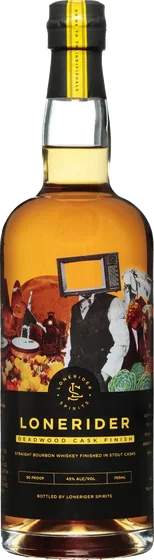
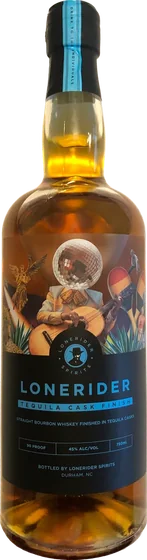
Two straight bourbons, each given a second cask after its time in charred new oak. Deadwood Cask Finish is a straight bourbon whiskey finished in stout casks, 90 proof, a collaboration with a sister brewery. It is robust and made for seasoned bourbon drinkers; try it neat or in a stirred cocktail. Tequila Cask Finish is a straight bourbon whiskey finished in tequila casks, 90 proof, light and easy in character, and a good fit for cocktails that call for an anejo tequila.
FAQ
What is the difference between bourbon and straight bourbon?
Straight bourbon must be aged at least 2 years in charred new oak barrels and cannot contain added coloring, flavoring or blending materials. Plain bourbon has no minimum aging time.
How old is straight bourbon?
At least 2 years. If it is younger than 4 years, the label must state its age. Above 4 years, the age statement is optional.
Is bottled in bond better than straight bourbon?
Bottled in bond is stricter, not necessarily better. It requires one distiller, one distillery and one distilling season, at least 4 years of aging and bottling at exactly 100 proof.
Can straight bourbon have additives?
No. Straight bourbon cannot contain added coloring, flavoring or blending materials. Water may be used to bring it to bottling strength.
Is straight bourbon the same as straight whiskey?
Straight bourbon is one kind of straight whiskey. "Straight whiskey" with no grain named covers whiskey whose mash does not reach 51% of any single grain, aged at least 2 years in charred new oak.