
Liqueurs vs Flavored Whiskey: What the Labels Actually Mean
What the Labels Actually Mean
Under US federal rules, a liqueur (or cordial) is a distilled spirit mixed or redistilled with fruits, plants or other natural flavoring materials and containing at least 2.5% sugar by weight. A flavored whiskey is a spirit that first meets the legal standard for whiskey, then has natural flavors, wine or other flavoring added, and it must be bottled at no less than 30% alcohol by volume (60 proof).
Both are defined in 27 CFR Part 5, the federal labeling rules for distilled spirits (as of 2026).
Quick facts
- Liqueur and cordial mean the same thing under US rules (27 CFR 5.150).
- Minimum sugar in a liqueur: 2.5% of the finished product's weight.
- Flavored whiskey minimum: 30% ABV, or 60 proof (27 CFR 5.151).
- Bourbon liqueur: at least 30% ABV, with bourbon making up at least 51% of the spirits on a proof gallon basis.
What legally makes a liqueur or cordial?
The federal standard of identity, 27 CFR 5.150, defines cordials and liqueurs as flavored distilled spirits made by mixing or redistilling spirits with or over fruits, flowers, plants, their pure juices or other natural flavoring materials, with sugar (sucrose, fructose, dextrose or levulose) of at least 2.5% by weight of the finished product.
A few things follow from that:
- "Dry" has a meaning. A liqueur can carry the word "dry" only when its sugar content is below 10% by weight.
- There is no general minimum proof. Alcohol minimums apply only to certain named types.
- "Straight" is off limits. A liqueur cannot be called straight, even if it is made from straight whiskey.
Named types of liqueur
- Bourbon liqueur or rye liqueur (also "bourbon cordial"): at least 30% ABV, at least 51% of the spirits on a proof gallon basis must be the named whiskey, and that whiskey must be the predominant flavor.
- Rock and rye, rock and bourbon: at least 24% ABV, made with rock candy or sugar syrup, with the named spirit as the predominant flavor.
- Crème de (flavor): a liqueur named for its main flavor, as in crème de menthe (mint) or crème de cacao (chocolate). "Crème" here describes a sweet, syrupy liqueur, not dairy.
- Others: sloe gin, amaretto, triple sec and curaçao, anisette, sambuca, peppermint schnapps, kümmel and goldwasser.
What is flavored whiskey?
Flavored whiskey falls under 27 CFR 5.151, which covers flavored spirits of every base class:
- The base must be real whiskey first. The base spirit must conform to its own standard before flavoring is added.
- Natural flavors only, plus wine. If wine exceeds 2.5% of the volume, the label must state the kinds and percentages.
- Minimum strength of 30% ABV (60 proof). Plain whiskey must be at least 40% ABV.
- Specific naming. The label must name the single base spirit and one or more of the most predominant flavors. The regulation's own examples are "Pineapple Flavored Tequila" and "Cherry Vanilla Flavored Bourbon Whisky."
So "pecan flavored whiskey" on a label tells you three facts: the base meets the whiskey standard, pecan is the predominant flavor, and the bottle is at least 60 proof.
Liqueur vs flavored whiskey: the practical difference
| Liqueur or cordial | Flavored whiskey | |
|---|---|---|
| Regulation | 27 CFR 5.150 | 27 CFR 5.151 |
| Sugar | At least 2.5% by weight | No minimum |
| Minimum ABV | None in general (30% for bourbon liqueur) | 30% (60 proof) |
| Base spirit | Any distilled spirit | Must meet the whiskey standard |
| Typical use | Sipping after dinner, modifier in cocktails | Neat, on ice, or as a whiskey swap in cocktails |
Flavored whiskey tastes like whiskey with an accent; a liqueur tastes like its flavor. A product that does not meet either standard (or any other standard of identity) may be labeled as a "distilled spirits specialty product" under 27 CFR 5.156, with a fanciful name and a statement of composition.
Cream liqueurs vs non-cream liqueurs
Cream liqueurs blend spirit with dairy cream and sugar, giving a thick, opaque drink. Part 5 has no separate standard of identity named "cream liqueur," so the label's designation and statement of composition tell you what is inside.
- Mixing: dairy can curdle when it meets acidic ingredients such as citrus, or some carbonated mixers. Non-cream liqueurs mix freely with juice, tonic and other spirits.
- Texture: cream liqueurs are rich on their own and over ice. Non-cream liqueurs are clear or translucent and lighter in body.
- Storage: cream products are more perishable once opened. Non-cream liqueurs are generally stable at room temperature, out of sunlight, though flavor fades over time.
Eggnog-style ready-to-serve drinks
Bottled eggnog-style drinks combine spirit, often bourbon or rum, with a creamy, spiced base, and are designed to pour straight from the bottle, usually chilled or over ice. Their legal class depends on composition, so read the label for the designation and ingredients.
Storage after opening is where people go wrong:
- Follow the label. If it says refrigerate after opening, do so, and finish it within the window the producer gives.
- Keep it cold if in doubt. Dairy and egg-based products keep best in the refrigerator.
- Check before pouring. Separation that will not shake back together, a sour smell or curdled texture means it is past its prime.
- Buy to the season. These are made to be enjoyed fresh, not cellared.
For more on reading the fine print, see how to read a whiskey label.
From Lonerider Spirits
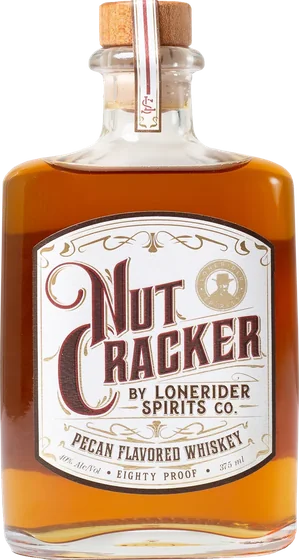
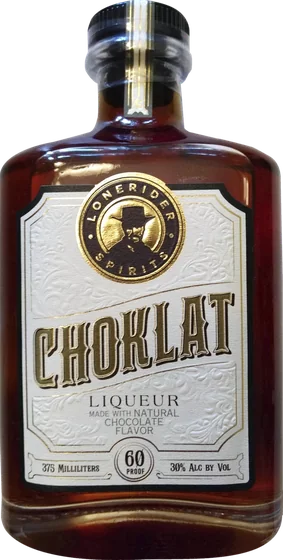
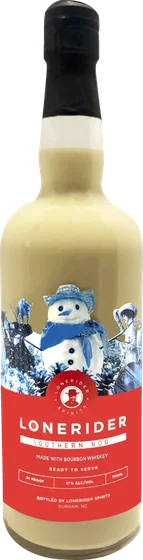
Lonerider Spirits bottles one of each style covered here. Nut Cracker is a pecan flavored whiskey, 80 proof, in a 375 ml bottle. Choklat is a liqueur made with natural chocolate flavor, 60 proof, 375 ml; it is not cream based, so it mixes easily with other spirits. Southern Nog is a seasonal ready-to-serve drink made with bourbon whiskey, 34 proof, 750 ml.
FAQ
What is the difference between a liqueur and a cordial?
In the United States, nothing. Federal rules (27 CFR 5.150) treat "cordial" and "liqueur" as the same category: flavored distilled spirits with at least 2.5% sugar by weight.
What proof does flavored whiskey have to be?
Under 27 CFR 5.151, flavored whiskey must be bottled at no less than 30% ABV, or 60 proof. Unflavored whiskey must be at least 40% ABV (80 proof).
Is flavored whiskey real whiskey?
Yes, in the sense that US rules require the base spirit to meet the whiskey standard before flavoring is added. The label must name the base and the predominant flavor, for example "Cherry Vanilla Flavored Bourbon Whisky."
Do cream liqueurs need to be refrigerated after opening?
Follow the producer's label. Dairy-based products are more perishable than other liqueurs once opened, and keeping them cold, tightly closed and away from heat is the safe default.
Can a liqueur be called bourbon?
Only as "bourbon liqueur" or "bourbon cordial," which requires at least 30% ABV and at least 51% bourbon among the spirits on a proof gallon basis. A liqueur can never be labeled "straight."